


Udaya Kasthuriarachchi is retiring from EGi after almost 32 years of service in our geochemistry laboratory. He is one of the longest-serving people in the company, and for most of EGi's history, he has run the tests our clients' decisions rest on.
EGi runs its own geochemistry laboratory, a core capability that differentiates us from most environmental geochemistry consultancies. At EGi, an integrated team designs the methods, runs the tests and interprets the results, delivering a higher level of quality assurance than if testing were outsourced. That assurance only works if the people at the bench work seamlessly with the consultants. For much of the past three decades, Udaya was that person.
Before EGi
Udaya graduated in chemistry from the University of Kelaniya in Colombo in 1986. He spent the next four years at Prima, a Singaporean food company operating in Sri Lanka, as a quality-control supervisor — running water-quality monitoring for prawn farming operations. This experience was his ticket for a skill migration visa to Australia.
In June 1992, Udaya and his wife — both chemistry graduates — landed in Sydney with an eight-month-old baby. They knew nobody — no family, no friends, no address.
"We told the people at the airport we don't know where to go," he said. The customs officer phoned a St Vincent de Paul hostel, paid for the taxi herself, and sent them there.
"It was the best welcome," Udaya says. "That's why I fell in love with Australia."
Migration officials helped them into a one-bedroom unit the following week. They enrolled him in a government-run job club at UTS, where the training covered how to find work in Australia and how to be understood with an Australian accent. His teacher there saw an EGi advertisement for a laboratory technician. He advised him to ask for work experience instead and he made the call himself to set it up.
Udaya completed three weeks of unpaid work experience in December 1994, just before the firm closed for Christmas. He must have impressed the small team because at the end of January, he got a phone call saying there was a position available and asking if he would come in for an interview.
In February he started work. It was his first job in Australia, and he has never had another.
The early days
EGi in early 1995 was around five people working out of a rented house. The kitchen was the laboratory, the laundry held a fume cupboard, and the garden shed out the back was used for sample storage. EGi's owner, Stuart Miller, and his wife, Maree, the admin manager, occupied the office upstairs.
Initially, all the testing was done by hand and the first innovation was the purchase of a single automatic Orion titrator, followed by several Metrohm units from 1996. Udaya remembers collecting results from a dot-matrix printer and keying them in by hand. Today, the instruments write straight to a laptop and into the document system.
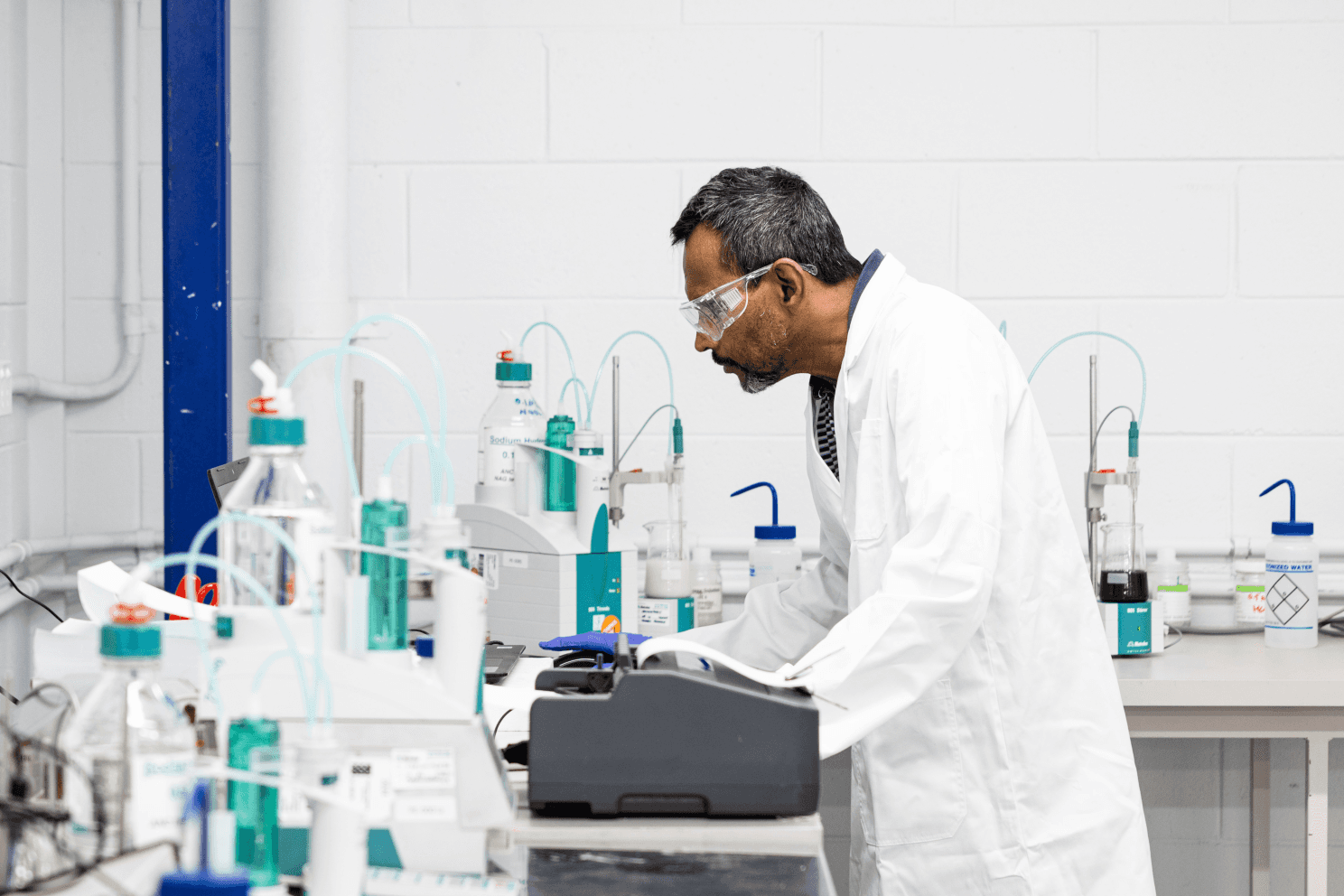
Udaya at the lab bench
When asked what has changed most over the years, Udaya was clear: the volume. In the early days, a mine might send a few samples, and testing for potential acid-forming materials was not ubiquitous. Today, it is much more routine and many more samples are sent. In parallel, EGi has grown and sample numbers have increased accordingly.
As the company grew, EGi bought its own facility in Balmain, where the laboratory stayed until the recent move to its current Castle Hill home in 2023.
Helping develop the methods
Over the years, Udaya was closely involved in developing a range of new testing methods, all pioneered by EGi. The first was when Stuart Miller wanted to extend the NAG test—net acid generation, a key measure of whether a material will turn acid. The single-stage version had a known blind spot: some samples do not react at first, because minerals present in the material get in the way of the reaction. The result comes back looking harmless when it is not.
Stuart's idea was to run the test in stages, drawing off the liquor between each one and starting again on what remained. Working out how to actually do that largely fell to Udaya, working closely with Stuart.
"We tried different methods for how to do that," Udaya says. Filtering was the obvious first option, but it did not work. Eventually, a solution was developed using a small pump to siphon the liquor off between stages. The sequential NAG test now runs to as many as twelve stages on a difficult sample.
Around the turn of the century, other EGi methods were formalised in the AMIRA ARD Test Handbook, which much of the industry still tests to. Udaya was one of the people running the test work behind it — samples drawn from mines around the world, results collated into what became the reference document for the field.
The most recent big change was the advent of certified reference materials, which arrived about four years ago. EGi organised and ran the ANC and NAG test program, working with other laboratories to develop the reference materials. Today, every job now incorporates a reference material as a check.
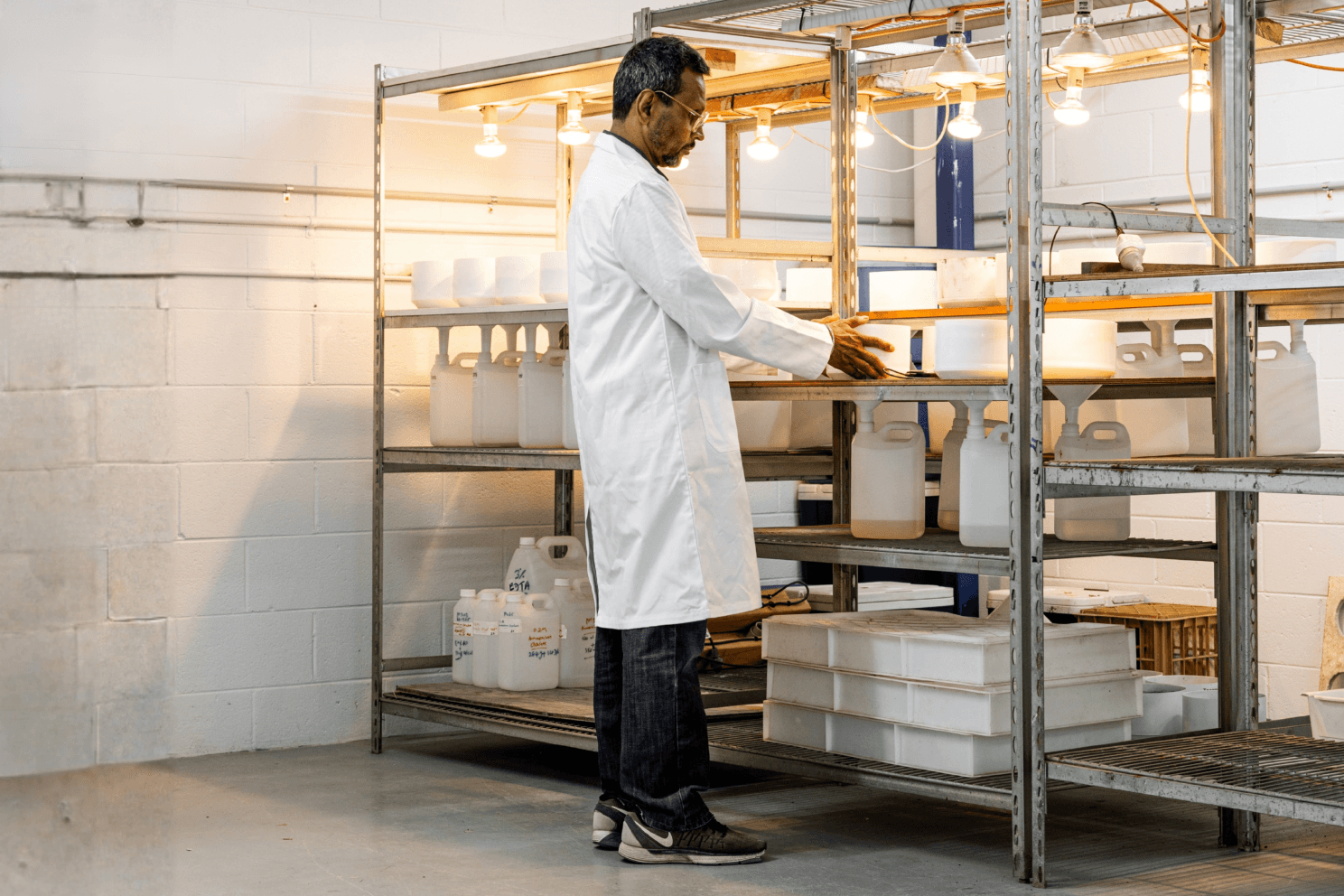
Asked what the most interesting work he had done over his time at EGi was, Udaya nominated a project in 1997 testing cyanide decay from CIL tailings of a gold mine. Drums of low-concentration cyanide liquor arrived from the mine and Udaya had to run all the tests with a mask. John Jeffery, who is still with the company today, designed a test for them that simulated a tailings beach. The liquor was pumped from a reservoir to the upper end of the simulated beach and discharged through a diffuser that distributed the liquor evenly across the slope. At the bottom end of the beach, the decant was channelled by a raised V-shaped wedge and funnelled back into the decant reservoir. The liquor evaporated over days while its concentration and mineral content were tracked.
Delivering quality consistently
Udaya's biggest contribution is his dedication to consistent quality assurance in the testing processes.
"The most important thing after chemistry knowledge is to be organised in your lab. If you take something out, put it back in the same place. Everything should be neat and tidy, so that everything is repeatable."
EGi's Laboratory Manager Russell Schumann says: "When you have been working in a lab as long as Udaya has, you get a feel for things. Having helped develop them, he understands how the tests are meant to work, so he is quick to spot any inconsistencies rather than letting them pass through."
Udaya himself said that on a large-sample run, one or two samples will occasionally come back looking wrong.
"I spot those and usually repeat them immediately. Mostly they come back with a normal and expected result. Then I know there was just some small variance in the acid dosing or some other minor source of error. Occasionally the result really is unusual, and I tell the consultants about it immediately."
Udaya said most tests were straightforward but nominated the Acid Neutralising Capacity (ANC) test as the most challenging as it requires some judgement.
"You add a measured volume of dilute acid to the sample and then watch. How vigorously the sample fizzes tells you how strong the acid needs to be for the rest of the test. Some samples do not fizz at all, and that is a result in itself. Others come back above the pH 2 cut-off and need another stage. No instrument makes that call for you."
What he leaves behind
Russell Schumann said: "Another thing I have valued and will miss is his amazing corporate memory. He has been there right from the start and remembers every mine we have ever worked on. So when EGi returns to a mine we worked on 30 to 40 years ago, he remembers all the tests we did and any nuances about the tests we ran before."
While Udaya's retirement is a loss for the company, EGi is fortunate that his long-time colleague of 25 years, Ai Binh Tran, remains at the company. In addition, EGi has just engaged Anjali Krishnankutty as another laboratory chemist to carry on the work.
Asked why he stayed his entire career with the company, he says:
"It was mainly the people I work with." Maree and Stuart Miller, along with John Jeffery at the start; Warwick Stewart when he took over the company, and his fellow laboratory technicians. "I get on so well with all of them."
He particularly appreciated his collaboration with all the consultants. "They trust me to get on with the job. I have a lot of independence on how I conduct the testing."
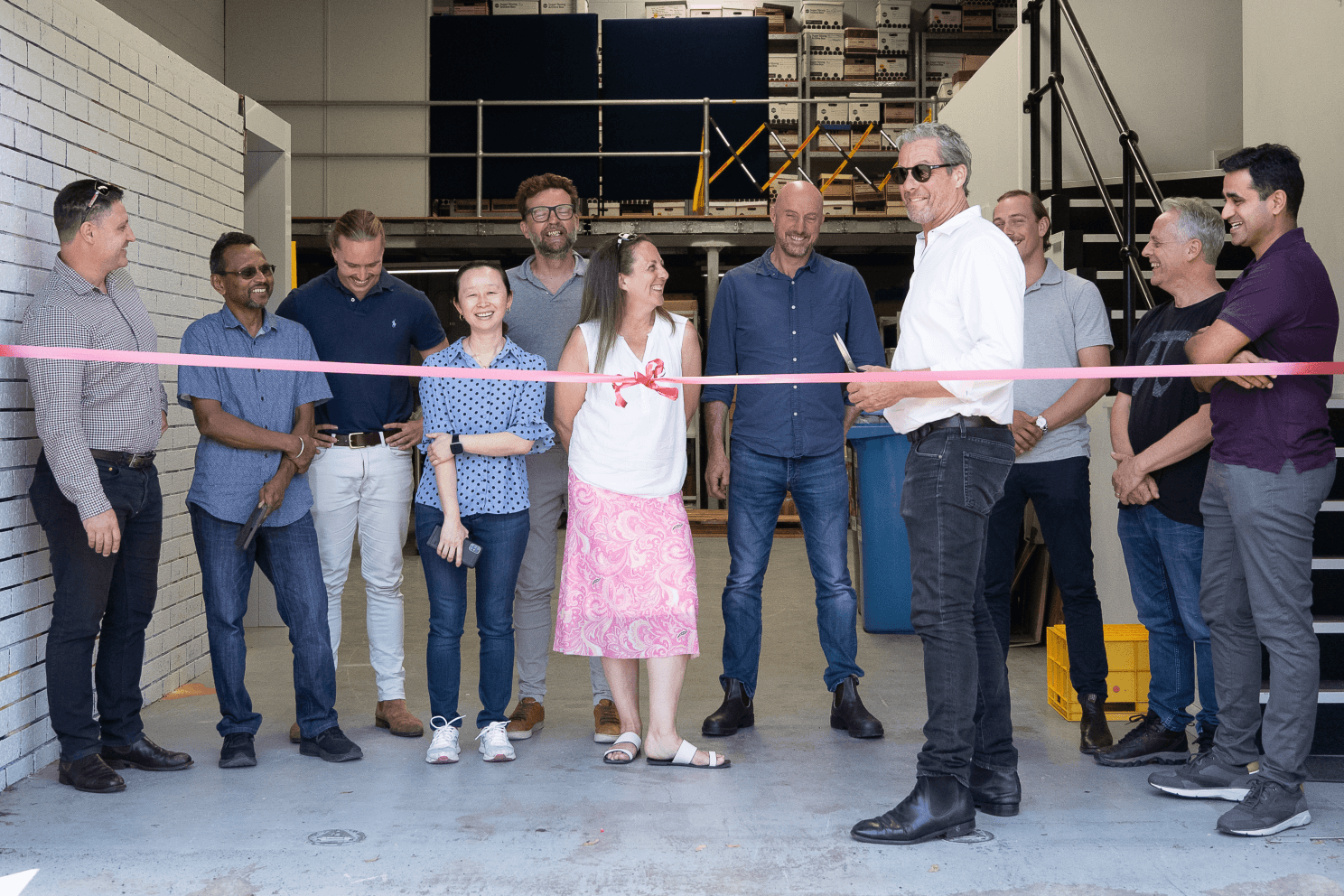
Udaya (second from left) watches as EGi Managing Director Warwick Stewart (fourth from right) officially opens the company's new Castle Hill laboratory, along with many of the team he loves working with.
What comes next
Udaya's first retirement adventure is to spend a few months in Sri Lanka. Then, after his wife retires at the end of the year, they will embark on road trips in a Mercedes Sprinter campervan they have just bought, aiming to travel all around Australia.
Thank you, Udaya, from all of us at EGi and on behalf of every client who received a reliable service because you were the one running the test.


CONTACT US